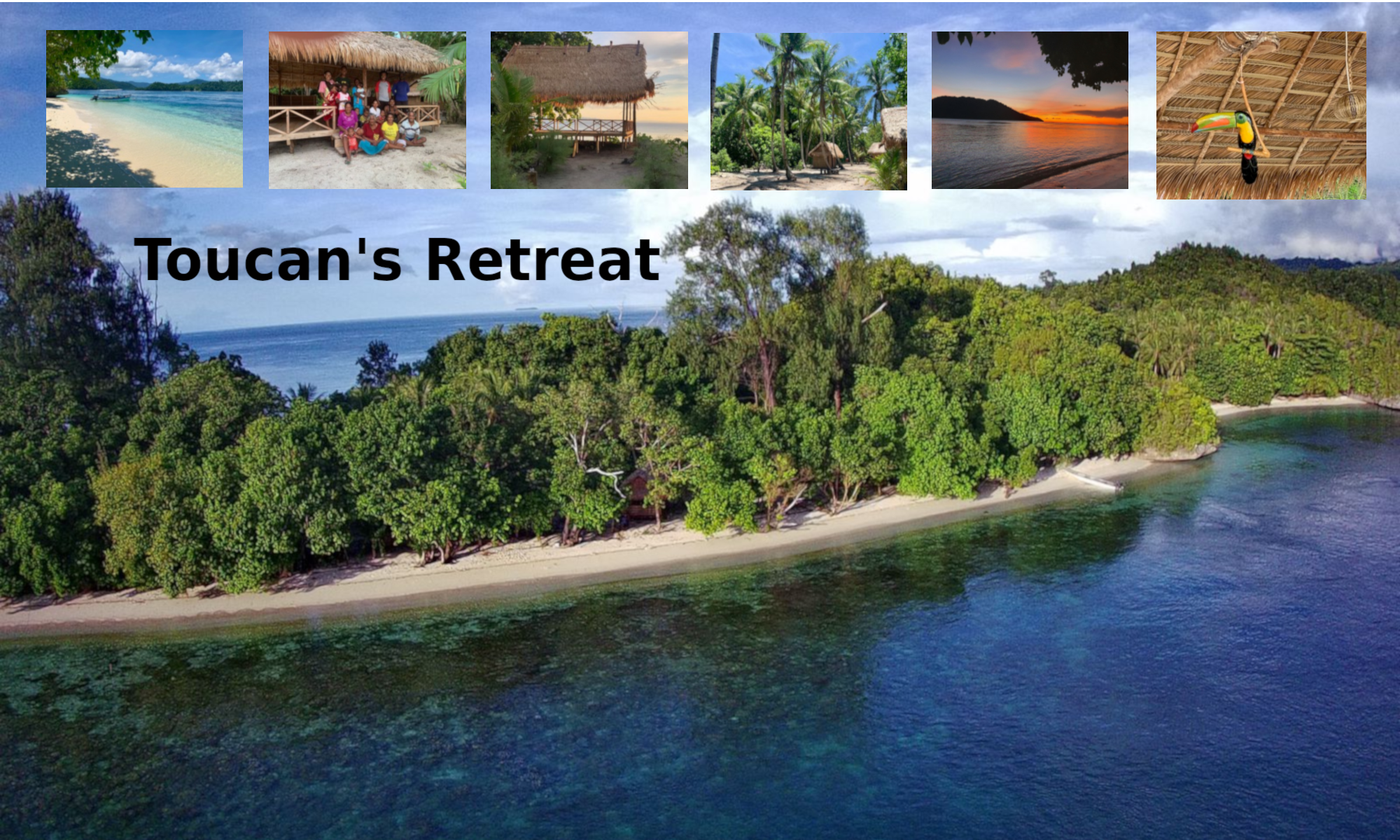
I actually wanted to use “I Can See Clearly Now” as the title for my blog but Di quietly whispered that she had recently used that exact title for a recent blog. So, in my desperation, I reached out and grabbed the first idea that came to mind. Not sure if it’s the best title – in fact, I’m not sure if it was a great song in its day either but hey, I live on an island in the middle of nowhere so I’m sure the title will be fine.
Tourists that pass often comment that we live in paradise and that we’re living the dream. I guess if you took out the tourists and the large amount of plastic rubbish that floats past from time to time then, yes, I guess we’re living the dream. But even paradise has caveats. For us underwater photographers one of those caveats is clarity. Not clarity of mind, though that does help when you’re trying to justify what the hell we’re doing here, but visual clarity. The ability to see our underwater environment. I like taking photographs of big things. Probably because my eyesight is so bad. At least I can see what I am trying to photograph. Di, on the other hand, searches for small grains of sand that happen to move. Macro photographers, seriously. Because she has her head stuck in the sand most of the time, the clarity of the water isn’t so important to her – here are some of her recent shots with her new Olympus EM-10 Mark IV proving the point:
A beautiful tube anemoneA juvenile Barramundi looking like a cartoon characterA stunning Caloria indica nudibranch (sea slug). This little guy is about the size of my pinky fingernail!Gorgeous Christmas Tree worm in all its fineryA family of False Clown anemone fish in their home
For me, the complication is that not only do I require good visibility, but I also prefer minimal current (try hanging on in 4 knots of current with a large camera rig!) and preferably sunshine and flat seas. Not too much to ask really. I’m not sure if it’s climate change or natural cycles but our weather this year has been very different from previous years. This makes it hard to plan trips to some of the better dive sites because you need stable weather, not wind blowing dogs off chains, and sea conditions that aren’t classified as a washing machine to be able to dive many of the sites. Not too far from where we live and within an hour’s boat ride, we can access some great dive sites where visibility sometimes exceeds 40 metres and usually sits around 30 metres. At home we generally only see somewhere between 5 – 10 metres with the odd 20-metre day. So, breaking out and diving in 30-40 metres is a big drawcard.
Recently, we had the great fortune to experience some sunny stable weather and glassed out seas for a couple of days so we jumped at the opportunity. As a result, I thought I’d load you up with some of my photos from our recent trips and show you how we waste our time here in paradise…
Jetties such as this one at Arborek provide interesting subjectsA good day at our local dive site which is abundant in fish life.Raja Ampat has amazing soft coral life. This fan we found at 30 metres.A very friendly bat fish.One of the many types of colourful soft corals found around our dive sites.There is never a shortage of schooling fish on the local reefs.A very persistent Bat Fish followed us for all of the dive.From a dive site we know as Citrus Ridge which is simply covered in beautiful soft corals and fans such as this one.Caught unaware by my sneaky photography buddy.
It’s hard to believe, but this New Year’s Eve will mark our 30th wedding anniversary. Who would’ve thunk it?! What a ride it’s been – ups and downs (of course) and a few rocky patches but through it all there’s been immense, enduring love and a shared passion for adventure and living life to the full. It’s traditionally known as the pearl anniversary – symbolizing strength and endurance (definitely!) wisdom (hmm, the jury’s out on that one), and patience (haha, definitely some work to do there).
We think it’s a pretty big deal so we decided to treat ourselves to some special trips.
First, we made a quick trip back to Cairns for Millie’s “Fairy 1st” birthday, which was just delightful and so wonderful to see how much she’s grown – now walking and learning new things every day. Sally and Nick did an amazing job of creating the fairy theme, and how lovely to see so many blokes happy to don a pair of fairy wings! Great fun had by all.
And then on our way back we did a side trip to Borneo to see the orang-utans in the wild. Several of our cruising friends had done this trip up the river at Kumai, and it was always a regret of mine that we never got there in Toucan. But there’s more than one way to skin a cat as they say, so we hopped on a plane from Jakarta to Pangkalan Bun in Kalimantan province (it’s not big enough to have its own airport, so the commercial flights use the army base airstrip) and from there we were picked up by our lovely guide, Adin, from Sister Tour and whisked off to Kumai to join our houseboat (or klotok as they’re known locally). The klotoks are wooden, two-tiered traditional boats with the upper level reserved exclusively for the use of the guests (usually just a couple or sometimes a family), with a western toilet and shower, double mattress with mosquito net, dining table, and lounging chairs. The crew, consisting of the captain, cook, deckhand, and guide, are quartered in the lower deck. We signed up for the 2 night/3 day tour.
Kumai is only a small town (approximately 25,000 people) but it’s the centre of the very lucrative bird’s nest soup industry, where large concrete birdhouses attract the many thousands of swiftlets to nest. The nests, made out of the bird’s saliva, are considered delicacies in Chinese cooking, and reportedly have medicinal benefits such as helping collagen production for women’s skin, and for male virility. A kilo of birds’ nests can fetch up to $3000 these days, so it’s a very large export market for Indonesia. It’s kind of weird to arrive in Kumai and see all these large concrete buildings with small holes for the birds to enter, and to hear the amplified recordings of the birdsong, which supposedly attracts the swiftlets to nest. These types of strange food choices always make me wonder – who was that first person who decided that cooking a bird’s nest would be a good idea? I mean, it’s not like it was an accidental discovery. Aren’t humans fascinating?!
The large concrete buildings are all birdhouses for the swiftlets to nest in
Anyway, I digress. The trip up the Sekonyer river takes you into the Tanjung Puting National Park, an area of roughly 1 million acres dedicated to the conservation of diverse ecosystems and the protection of the endangered Bornean orangutans.
our gorgeous home on the water for two nightsAh, the serenity…Our crew for the trip: Adin our guide, Captain Abdul, Mahdi the deckhand and Ani, the amazing cook
Adin, our guide, was incredibly knowledgeable and informative so we learnt a lot during our trip. For instance, there are approximately 1600 wild orangutans in the national park, and an additional 400 that are ‘semi-wild’ – those that have been rescued from captivity or orphaned, who are then rehabilitated and returned to the wild. This work started in 1971 when Birute Galdikas established Camp Leakey (named after her mentor, the famous paleoanthropologist Louis Leakey) to study orangutans for her doctorate. Apparently, Leakey jokingly referred to his three primatologist proteges – Jane Goodall, Dian Fossey, and Birute Galdikas- as the “trimates”. Sadly, Galdikas is the only surviving “trimate” now, and is still actively working in Borneo on her life’s work of studying and protecting the orangutans. There are now two other “camps” or release sites on the way up the river to Camp Leakey, where tourists can observe the orangutans up close at the feeding platforms. I’m so glad that we did this trip in the low season as there weren’t many other boats and only maybe a dozen tourists at each camp. In the peak season of June- October, Adin told us there could be as many as 200 people at the feeding stations! Ugh! My only regret is that we didn’t have a better camera with a telephoto lens, so we had to make do with our phone cameras and my little Olympus TG6, hence the resolution on the photos isn’t great. But hopefully you get a sense of how amazing it was to see these magnificent apes in the wild.
On a mission to get those bananas…Just hangin’ aroundOne of several older males, who can live up to 40 or 50 years – the younger males would make themselves scarce when they heard him comingA family group with the alpha maleA bit hot and sweaty in the jungle, but well worth it!Mumma, adolescent and baby, with macaque monkeys
The monkeys can be quite threatening to orangutans and humans alike – one of the comments Adin made to us as we approached a group of monkeys on the boardwalk was “whatever you do, don’t look them in the eye” – they really are the gangsters of the jungle!
Here’s a little clip of an interaction between the orangutans and the macaque monkeys:
Despite being the rainy season, the weather was perfect – a couple of showers at night, but the days were fine and sunny. We chugged our way slowly up the river, stopping at the three camps for the scheduled feeding times, and looking for wildlife along the way. Adin and our skipper Abdul were extremely good spotters so we were treated to several sightings of wild orangutans, as well as macaque monkeys, the comical-looking proboscis monkeys, and flashes of vividly coloured greater kingfishers.
Very exciting to see a wild orangutan near the riverbankProboscis monkeysThe colourful greater kingfisher
At night, we tied up to the riverbank and had a very comfortable night’s sleep under our mozzie net.
Tied up to the reeds
Ani, our cook, served us up huge quantities of the most delicious food for every meal. All in all, the tour was everything and more that I hoped it would be, and we came away with many wonderful memories.
And now we’re back in our island home enjoying the peace and quiet once more. There’s always lots to do when we come back after a time away, so the last ten days have been spent cleaning, raking, getting the watermaker going again, removing plastic from the beach and generally tidying up. We’re also recovering from a cold/flu virus we must’ve picked up from travelling (in hindsight, the wisdom definitely needs more work – we should have worn masks on the plane), but hopefully we’ll get back in the water soon so I can play with my new camera ( a little extra anniversary present – lucky me!). The island Christmas tree is up, Nigel the duck has forgiven us for being away, and Elvis the palm cockatoo is still doing his daily beach walk.
In these times of so much turmoil and hate in the world, we give thanks for the life we’ve managed to build together, and for the love of our family and friends. Every day is precious. Wherever you are this Christmas, may peace and love surround you, and may 2026 bring many more adventures and happy times for all of us.
The rain has gone. Well, almost. August and September were very wet months and now we’re into October and the downpours are becoming less. Our local centres of Waisai and Sorong have suffered some terrible flooding this year, which many locals blame on the amount of plastic garbage blocking the drains and waterways. Who knows, maybe it’ll be the impetus the local government needs to take action? One can only hope.
I had every intention of writing more frequent blogs this year. With passing time, it gets harder to remember all the small events that happen on a day-to-day basis, and one thing I’ve learnt is that it’s the small stuff that matters. Things like our resident pair of Raja Shelducks hatching a clutch of 8 chicks, the micro-bats that flit past our faces as dusk falls, and the herons that delicately pick their way along the shoreline in the golden evening light. But I look at the calendar and see that we arrived back from Australia 6 weeks ago, so that plan hasn’t exactly worked out. But I’ll keep trying!
Our trip back to Australia in April was necessary for Bruce’s skin cancer removal and thankfully his surgery was a success. So, barring any more suspicious lumps appearing, we plan to stay here now until early 2026. It goes without saying that it was also wonderful to catch up with all our friends and family members and see how much our little granddaughter, Millie, has grown. She’s now 8 months old and the apple of all our eyes. Saying goodbye is always the hardest part….although she did kindly leave us a parting gift of a cold/flu bug that hung on for a week or so after we got back!
The marvellous Miss Millie. What a joy she is!
Our first challenge when we got back to Sorong was to work out how on earth we were going to get all our goods onto our boat and back to the island. Not only did we have our suitcases, 10 jerry cans of fuel, several boxes of dry foodstuffs and an esky full of frozen food but we also had a new chest fridge/freezer and a new fibreglass dinghy and outboard motor to squeeze on somehow. The staff at the marina are used to our shenanigans but even they were shaking their heads in disbelief! Somehow, we managed to load it on with the help of our friends and off we went, a boat-within-a-boat obscuring our forward vision quite considerably! I wish I’d got a photo of the whole show at the dock, but these images underway give you some idea.
Probably not Col Regs approved….!Yet again…another boatload of goods
Thankfully the weather was reasonably kind to us on the trip, and Hans and his family (and even our neighbour, David) were there to help us unload at the other end. It probably only took them 15 minutes. What a godsend they are, and how lucky we are to have their help and the use of their muscles!
It’s always a challenge coming back after some time away. The mud wasps had been having a field day in our absence so there was a bit of cleaning up to do, plus all the unpacking and general maintenance. The first item was the main water pump – the impellor had seized – so Bruce quickly got to work to fix that so we had running water again. Meanwhile I was in the bedroom putting up the mosquito net and making the bed when I heard a peculiar loud buzzing sound, like a wasp on steroids. The next minute there was a pop, and flames started coming out of our hanging light fitting. Holy crap! I quickly turned the light switch off and luckily the flames fizzled otherwise we would have had another building burn down. Not great on our first day back. It turns out the wiring to the light fitting had corroded due to the salt air and moisture, building up resistance. We decided to do without the light that night as we were too tired to fix it, but the next day Bruce had to rewire the whole section from the light switch to the hanging light, delicately balancing on the beams above the bed as he did so. He’s a talented man, what can I tell you. We’ll now have to check all the other electrical fittings as there’s a fair chance it’ll be a common problem after nearly three years since the initial wiring was installed.
With that excitement over, we’ve settled back into island life. Many of our plants survived thanks to some watering help from Hans, but the mint and basil didn’t so I’ve planted some more seeds and we’ll start again. Surprisingly, my hydroponic capsicums are still alive and starting to flower, so with a little TLC they should be producing a crop of mini capsicums before too long.
We bought the little dinghy so we could do more local diving on our own without needing to have a driver for the big boat. It means we’ll have to take turns towing the dinghy when we dive while the other one takes photos, but we’re hoping it’ll give us more freedom to get to the local sites whenever the mood takes us. Hans and his family have been so busy with their homestay business that we’ve been finding it hard to get a driver when we needed one, and often we’d organise something and then have to cancel because the weather was no good. So, we’ll see how it goes…
Made of fibreglass and lightweight, we hope this serves us well
Unfortunately, we’ve encountered a few teething problems – with the 15hp motor on, it’s heavier than we thought, so currently we either have to put fenders underneath it and roll it up the beach, or tie it to the bigger boat on the mooring. Our next plan is to build a trolley with wheels to make our life easier (I hope!). Also, our towing reel broke on our second outing and anchoring the dinghy isn’t an option due to the strong currents, so we’re a bit stuck until we can replace the reel on our next trip to Sorong in a month’s time (unless the marvellous Mr Fix-It can work his magic). To cap off our diving woes, Bruce accidentally flooded his camera (a very terminal event) so he’s now desolate and camera-less until he can order a new one. For the time being, he has to be content being my dive buddy and nudibranch-spotter. It’s incredibly hard to find these teeny-tiny critters, so every dive feels like we’re on a treasure hunt and I’m very grateful for whatever help he can give me. Here’s a few pics of some little beauties we’ve managed to find in the last few weeks. For each one we find, I’m sure there’s another ten we miss!
Hypselodoris tryoni nudibranchNot a nudibranch, but this flatworm is still rather stunning all the samePhyllidia ocellata, commonly known as the popcorn nudiOne of my favourites – the very pretty Goniobranchus kuniei, flapping its skirt like Marilyn Monroe
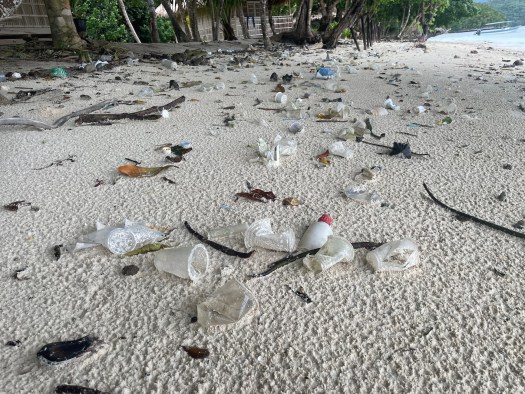
Typically, this isn’t a great time of year to be here. It’s the low season with lots of wind, rain, and swells, and with the swells comes all the plastic garbage. Again. I despair….
Plastic as far as the eye can see…
Thankfully, it’s only really bad when the westerly/north-westerly winds blow and as they’re not so frequent this time of year we’ve had a bit of a respite from the trash for the past few weeks.
We both had our birthdays last month so we had some quiet little celebrations, but we did manage to have a special dinner of chilli prawns followed by Aussie steak on both occasions.
Even a tropical downpour couldn’t deter Bruce from cooking me a delicious dinner
We miss everyone back in Australia, but it’s good to be back in our peaceful little part of paradise. The tranquility and feeling more connected to the natural environment is something I love – being aware of the moon and tide phases and being able to look up on clear nights and see a myriad stars reminds us of our time sailing Toucan across the oceans. There’s also the delight of watching baby reef sharks hunting in the shallows, seeing dolphins and turtles from our lounge room as we sip our morning cuppa, and enjoying the ever-present bird songs as we go about our day. It’s a far cry from the hustle and bustle of the crazy world out there, and it”s definitely good for the soul.
When we arrived back here in January, the plan was to stay until June and then return to Australia for a couple of months to avoid the rainy, windy months of June and July in Raja Ampat. Most of our major projects on the island are now finished, so finally we’ve been able to enjoy more of what we love – diving and taking photos.
We’re now back on Pulau Dayan after a very special 2-month visit back to Australia in November/December to welcome our first grandchild into the family. Millie Rose is perfect (of course!) and we were just so overjoyed to meet her and help Nick and Sally in those first few overwhelming weeks. No one can really prepare you for having a child, but Nick and Sal are such natural, loving, parents that they didn’t need much help in that department – but the cooking, shopping, washing, and occasional Millie cuddles when she wouldn’t settle were something we were very happy to provide. Being grandparents is a wonderful job! We’ll miss them dreadfully of course, but thank goodness Starlink will allow us have video calls and regular chats now that we’re back at Toucan’s Retreat.
We’re also very grateful to our friends Rusty and Tibby, who were caretaking in our absence and kept the place running while we were away. Unfortunately, the king tides over Christmas caused significant erosion of the beachfront, and our lovely tree fern outside the living room is now growing horizontally on the sand. So, our next big project will be trying to protect our beachfront, otherwise our living room may be in danger of becoming an over-the-water bungalow.
Our poor tree fern is determined to survive even in the prone position. We’ve lost probably a metre of foreshore since we first built here 3 years ago.
The other sad news is that a mass coral bleaching event has been unfolding in Raja Ampat since we’ve been away. By all accounts, it’s not as bad around our island as it is in other parts of the region, but seeing the once-vibrant soft and hard corals reduced to pale, white shells of their former selves is still devasting. This is a stress response to increased water temperature and/or pollution, causing the corals to expel the algae that normally live inside them and give them their colour. Scientists believe this current event is the result of record-breaking marine temperatures fueled by climate change and the recent El Nino conditions. The last time Raja Ampat experienced coral bleaching was 2016, and to a lesser extent in 2021. Then, the corals were able to recover after approximately 12 months, so there’s still hope that this current event is survivable too. But in the meantime, it’s achingly sad to see. And a dire warning about how vulnerable our marine ecosystems are to global warming.
It breaks my heart to see these once-vibrant corals reduced to this…
The reefs in the shallow, warmer, water are most affected, so we’ve still been able to enjoy diving in the deeper water, discovering some new and old friends. It’s wonderful to be back, although we’ve noticed the visibility is worse and there are fewer nudibranchs around than this time last year. I wonder if it’s connected to the bleaching event and the stress the marine system is currently under.
Still plenty of colour in the deeper waterI know they’re supposed to be pests, but lionfish are still extraordinarily beautiful creaturesA curious little hawkfishThis Goniobranchus coi nudibranch always reminds me of plum pudding and custard! These Nembrotha purpureoliniata nudis are quite common on our dives, but I always love finding themAnd finding this blue-ringed octopus in full regalia was a highlight of a recent dive
Hans’s family have also put new roofs on the beach cabana and our bedroom while we’ve been away, so we’re now nice and dry at night. And just as well too, as we seem to be having regular nighttime downpours in the last couple of weeks. We’re finding that the roofs have a life of about 3 years, so next to be replaced will be the two guest houses, but otherwise, all the buildings are standing up well to the elements.
The beach cabana getting a makeoverAnd the finished result. The perfect spot for some R & ROur bedroom with its brand-new leakproof roof
In the next couple of months, we’re hoping to get a bit further afield with our diving and explore some sites that are new to us, but as always that depends on the weather and whether we can get a driver for the boat. Now that Hans and his family are flat out with guests at their homestay it’s a bit harder to find someone, but I’m pleased for them that their business is going so well. And thankfully, on our side of the bay, our new signs on the beachfront seem to be successful in keeping those pesky tourists from wandering through our property. So, all in all, everything’s good at Toucan’s Retreat and we’re happy to be back living the simple life again.
I’ll leave you with a beautiful image that Bruce took recently of a fan coral – and no, this one isn’t a victim of bleaching, it’s naturally white. ‘Til next time…